
UK Betting on NBA Players: The Data-Driven Guide for 2026
 Available in US
I placed my first NBA player prop eleven years ago — a points over/under on a Tuesday night game that most UK punters would have ignored entirely. The line was soft, the research took me forty minutes, and the return was modest. But it taught me something that a decade of following this market has only reinforced: basketball betting rewards the analytical mind in ways that football and horse racing rarely do. The NBA generates a stat sheet after every single game that is more granular, more public, and more exploitable than anything in European sport. And the UK market is finally catching up to that reality.
The global basketball betting market sits at $8.7 billion, with the NBA alone accounting for roughly 60% of that revenue. That is not a niche — it is a major vertical that UK-licensed sportsbooks have been quietly expanding over the past three seasons. Meanwhile, the UK sports betting sector generates approximately £2.48 billion in annual Gross Gambling Yield, and the fastest-growing demographic of punters — those under 30 — are disproportionately drawn to American sports. NBA viewership in Britain has climbed 40% since 2019, and those eyeballs are translating directly into wagering activity.
This guide exists because the current landscape of NBA betting content aimed at UK audiences is, to put it plainly, dominated by promotional fluff. Operator reviews, bonus comparisons, and surface-level explainers that tell you what a moneyline is but never how to evaluate one. I have spent over a decade analysing player prop markets, building projection models, and tracking how regulatory shifts reshape the odds you see on your screen. What follows is the analytical framework I use — grounded in data, shaped by UK-specific regulation, and structured so that every section gives you something actionable rather than another sales pitch.
Whether you are placing your first NBA wager or refining a system you have run for years, the approach here is the same: treat player-level markets as data problems, understand the regulatory environment that determines your available options, and never confuse volume of betting with quality of analysis.
$8.7 Billion
Global basketball betting market, NBA comprising 60% of revenue
£2.48 Billion
UK annual Gross Gambling Yield from sports betting
+40% Viewership
NBA audience growth in the UK since 2019
The Numbers, the Edge, and What Actually Matters
- The NBA player prop market is not a niche — basketball betting is an $8.7 billion global industry, and UK viewership has grown 40% since 2019, driving deeper market coverage at UKGC-licensed sportsbooks.
- Not all prop categories are equal: AI models show block props hitting at 69.9% versus just 55.7% for points, meaning your research should target low-variance statistical markets where predictability is highest.
- Four metrics form the analytical backbone — usage rate, pace, minutes projection, and cascade beneficiary analysis. All are publicly available and collectively outperform gut-feel betting.
- The 2025 integrity scandals and the Remote Gaming Duty increase from 21% to 40% are reshaping the market structure. Wider bookmaker margins and potential prop restrictions are incoming realities, not hypotheticals.
- Responsible staking (1-3% of bankroll per bet) and UK-specific tools like GAMSTOP, GamCare, and deposit limits are the non-negotiable infrastructure that keeps your analysis sustainable.
NBA Betting Market in the UK: Scale, Growth, and Opportunity
Three years ago, I ran a quick audit of how many NBA player prop markets a typical UKGC-licensed sportsbook offered on a regular-season Wednesday. The answer was around 40 per game. I ran the same check last month: over 120 per game on most major platforms. That single data point tells you more about the trajectory of this market than any trend report — the supply of markets has tripled because the demand has tripled.
Start with the global picture. The worldwide sports betting market is valued at $124.88 billion in 2026 and is projected to reach $325.71 billion by 2035, growing at a compound annual rate of 11.24%. Basketball occupies a meaningful slice of that figure, accounting for 15-18% of global betting activity. In the United States, where the NBA's cultural dominance is obvious, basketball generates roughly 31% of sportsbook activity. But the interesting story is not America — it is the rest of the world catching up.
$124.88 Billion
Global sports betting market valuation in 2026
15-18%
Basketball's share of worldwide betting activity
290 Million
Online bets placed monthly in the UK on real events
The UK betting market is one of the most mature in the world. Roughly 290 million online bets on real events are placed every month in Britain, and online platforms now process approximately 75% of all global sports betting revenue. Mobile applications account for 78% of that online volume. This is not a market transitioning to digital — the transition happened years ago, and the infrastructure for NBA betting from a UK sofa is as frictionless as backing a Premier League match.
What makes the current moment distinctive is sentiment. A survey from early 2026 found that 68% of UK bettors plan to increase their wagering activity this year. Some of that is driven by the approaching FIFA World Cup cycle, but a significant portion reflects the growing appetite for American sports content — particularly the NBA, which offers a combination of frequency, statistical depth, and market variety that football simply cannot match. An 82-game regular season plus playoffs means there are opportunities to bet nearly every day from October through June.
To put that monthly volume in perspective: 290 million bets works out to more than four wagers per UK adult every thirty days. That kind of liquidity is what transforms NBA player props from a niche curiosity into a commercially viable market for bookmakers.

The commercial incentives are aligned, too. The UK's Gross Gambling Yield for sports betting sits at approximately £2.48 billion annually. Operators are actively competing for the segment of punters who want more than Premier League accumulators — and the NBA, with its deep statistical ecosystem and growing cultural footprint in Britain, is the most natural expansion target. I have watched this shift happen in real time: five years ago, finding a UK bookmaker that offered NBA assists props required effort. Now it is standard.
Why NBA Is Booming Among UK Fans
Last January I was at the O2 Arena for the Orlando Magic versus Memphis Grizzlies game — the most-watched NBA Global Game ever staged in the UK, with over 18,000 fans packed into every seat. What struck me was not the basketball itself, which was solid, but the crowd. It was young, it was loud, and half of them were wearing jerseys of players who were not even on the court that night. These were not casual spectators dragged along by a novelty event. They were fans — the kind who stay up until 3am on a Tuesday to watch the fourth quarter of a regular-season game on Amazon Prime Video.

The numbers confirm what the O2 atmosphere made obvious. NBA viewership in the UK has surged 40% since 2019, with the steepest growth among viewers under 30. Fandom — defined as active engagement rather than passive awareness — has increased 24% since 2022, and the NBA now holds the position of the most popular American sports league among Gen Z in Britain. That last statistic matters enormously for the betting market, because Gen Z and younger millennials are the demographics most comfortable with mobile wagering platforms and player-level markets.
The broadcasting landscape has accelerated this shift. The NBA's partnership with Amazon Prime Video, finalised in late 2025, brought live games directly into the streaming ecosystem that millions of UK households already subscribe to. You no longer need a dedicated sports package or an illegal stream — the NBA is on the same platform where you watch "The Grand Tour". That accessibility has lowered the barrier to fandom, and fandom is the gateway to betting engagement.
Approximately 1.5 million people play basketball at least twice a month in the UK, making it the second most popular participation sport in the country behind football.
The growth is not confined to screens. Participation numbers tell an even more compelling story — basketball is already the second most popular participation sport in Britain, behind only football. Among children aged 11-15, it ranks second as well. The UK government has committed £400 million to its Community Sport Facilities Programme over four years, with £5 million in the first year earmarked specifically for basketball facilities. The NBA is matching that initial investment with its own £5 million commitment through 2028. When the Prime Minister and a major American sports league are co-investing in basketball courts across Britain, you are looking at structural growth — not a trend.
Sir Keir Starmer, UK Prime Minister: "Basketball is booming in Britain and this investment will help take it to the next level, opening up the game to thousands more people right across the country. This is about more than sport; it's about community, inclusion and inspiring the next generation to find their spark."
For betting purposes, all of this matters because audience size drives market depth. More UK fans watching the NBA means more money flowing into NBA markets at UK sportsbooks, which means tighter spreads, more prop options, and faster line movements. The ecosystem feeds itself: viewership creates bettors, bettors create liquidity, liquidity creates better markets. Five years ago, I would have described NBA betting in the UK as a specialist pursuit. Today it is mainstream, and the infrastructure reflects it.
Types of Bets You Can Place on NBA Players in the UK
A mate of mine — sharp punter, years of Premier League form — tried NBA betting for the first time last season and told me he felt like he had walked into a sweetshop blindfolded. The sheer number of markets available on a single NBA game can be overwhelming if you are used to football's relatively narrow menu. But that variety is precisely what makes basketball wagering rewarding once you understand the categories. Every market type serves a different analytical purpose, and knowing which one fits your research is half the battle.

The two broadest categories are player-level markets and game-level markets. Player props — bets on individual statistical performance — are the focus of this guide and the area where analytical edges are most consistently available. Game-level markets — spread, moneyline, totals — are the traditional backbone of basketball betting and remain important, but they attract sharper money and leave less room for the kind of data-driven edge that a disciplined UK punter can exploit.
Player Props
Bet on individual performance: points, rebounds, assists, three-pointers, steals, blocks, PRA combos. Lines set per player, per game. Analytical edge comes from matchup analysis, injury news, and usage data. Lower limits, wider margins, but softer lines.
Game-Level Markets
Bet on team outcomes: who wins (moneyline), by how much (spread), or combined scoring (totals). Lines set per game. Sharper pricing from high liquidity. Higher limits, tighter margins, but harder to find consistent value.
Beyond these two pillars, UK sportsbooks offer same game parlays (often called bet builders), where you combine multiple selections from a single game into one wager, and futures markets for season-long outcomes like the championship, MVP, or conference winners. Live betting — placing wagers while the game is in progress — accounts for 62.35% of online sports betting revenue globally and is particularly well-suited to basketball's fast pace and frequent scoring.
Player Prop Markets: Points, Rebounds, Assists, and Beyond
A player prop is a wager on whether an individual player will exceed or fall short of a statistical benchmark set by the bookmaker. The most common categories are points, rebounds, assists, three-pointers made, steals, blocks, and combined stats like points-rebounds-assists (PRA). Each market is priced as an over/under line with odds attached to each side.
The beauty of player props, from an analytical standpoint, is that they isolate individual performance from team outcomes. You do not need to predict who wins the game or by how much. You need to predict how one player will perform in one statistical category, given a specific matchup, game context, and minutes expectation. That narrower scope is where research pays off most directly.
Example: Points Over/Under
Suppose a bookmaker sets a player's points line at 24.5. The over is priced at 10/11 (decimal 1.91), the under at 10/11 (decimal 1.91).
You stake £20 on the over. If the player scores 25 or more points, your return is £20 x 1.91 = £38.20 (profit of £18.20).
If the player scores 24 or fewer, you lose your £20 stake.
The equal pricing at 10/11 both ways implies the bookmaker sees roughly a 52.4% chance of each outcome, with the margin built into the slight deviation from evens.
For a deeper look at how to analyse these markets using usage rate, pace, and injury data, the player prop strategy section of this guide introduces the specific metrics that sharpen your edge.
Prop bet — short for proposition bet. Any wager that is not directly on the game's final result. In NBA context, this most commonly refers to player statistical props (points, assists, etc.).
Game-Level Markets: Spread, Moneyline, and Totals
Game-level markets are the foundation of basketball betting. The moneyline is the simplest — you pick which team wins, with odds reflecting the perceived probability. The spread (called handicap in traditional UK betting) levels the playing field by assigning a points advantage to the underdog. A team favoured by -6.5 needs to win by seven or more for the spread bet to pay.
| Market | Fractional | Decimal |
|---|---|---|
| Favourite moneyline | 4/9 | 1.44 |
| Underdog moneyline | 7/4 | 2.75 |
| Spread -6.5 (favourite) | 10/11 | 1.91 |
| Spread +6.5 (underdog) | 10/11 | 1.91 |
Totals (also called over/under) set a combined score for both teams — say 224.5 — and you bet on whether the actual total lands above or below that number. NBA totals are particularly interesting because they respond directly to pace, which varies enormously between matchups.
Spread — the bookmaker's predicted margin of victory. Also known as the handicap or point spread. A spread of -6.5 means the favoured team must win by 7+ points for the bet to pay.
Moneyline — a straight bet on which team wins the game, with no points spread. Odds are adjusted to reflect the probability of each team winning.
One important rule: overtime counts for moneyline, spread, and totals bets. If a game goes to overtime, any additional points scored are included in the settlement. This is standard across UK-licensed sportsbooks, though player prop overtime rules vary — a distinction worth understanding before you place a bet.
Parlay — a single wager combining multiple selections. All legs must win for the bet to pay. Known as an accumulator (acca) in UK betting terminology.
How NBA Odds Work for UK Punters
When I first started pulling NBA lines from American sources to cross-reference against UK bookmaker pricing, I spent an embarrassing amount of time staring at minus signs and plus signs, trying to figure out whether -110 was good value or terrible value. The answer, it turned out, was that it was roughly the same as 10/11 — a fact that took me far too long to internalise because nobody had laid out the conversion cleanly. So here it is.
UK sportsbooks default to fractional odds — the format you know from the bookies at Cheltenham. A price of 5/2 means you win £5 for every £2 staked, plus your stake back. Decimal odds, which most European and many UK platforms now offer as a toggle, express the total return per £1: a decimal price of 3.50 means a £1 bet returns £3.50 (£2.50 profit plus £1 stake). American odds, which you will encounter constantly when reading US-based NBA analysis, use positive and negative numbers: +200 means a £100 bet returns £200 profit, while -150 means you must stake £150 to earn £100 profit.
| Fractional | Decimal | American | Implied Probability |
|---|---|---|---|
| 1/1 (evens) | 2.00 | +100 | 50.0% |
| 4/6 | 1.67 | -150 | 60.0% |
| 5/4 | 2.25 | +125 | 44.4% |
| 10/11 | 1.91 | -110 | 52.4% |
| 2/1 | 3.00 | +200 | 33.3% |
The conversion between formats is mechanical. For fractional to decimal: divide the numerator by the denominator and add one (5/2 becomes 2.5 + 1 = 3.50). For decimal to implied probability: divide one by the decimal price (1 / 1.91 = 52.4%). These formulas matter because implied probability is the language of value. When a bookmaker prices a player prop at 10/11, they are telling you they think the event has roughly a 52.4% chance of occurring. If your analysis says it is closer to 58%, you have found a positive expected value situation.
Calculating Your Payout
Suppose you back a player's assists over 7.5 at fractional odds of 6/5.
Stake: £25.
Profit if the bet wins: £25 x (6/5) = £30.
Total return: £25 + £30 = £55.
In decimal: 6/5 = 1.20 + 1 = 2.20. Return = £25 x 2.20 = £55. Same result, fewer steps.
The bookmaker's margin — sometimes called the overround or vig — is the gap between the implied probabilities of all outcomes in a market and 100%. A perfectly fair market would sum to exactly 100%. In practice, most NBA player prop markets at UK sportsbooks sum to 105-108%, meaning the bookmaker's edge is between 5% and 8%. That margin is wider than you will find on Premier League match odds (typically 3-5%) but narrower than niche football markets. Understanding margin is essential because it tells you how much your analysis needs to outperform the market just to break even.
For a complete breakdown of how to read line movements, calculate expected value, and compare margins across different bookmakers, the NBA betting odds explained guide covers the full framework.
Data-Driven Approach to NBA Player Betting
Early in my career analysing NBA props, I made a mistake that cost me more than any single bad bet: I treated all prop categories as equally predictable. Points, rebounds, assists, three-pointers, steals, blocks — I applied the same research depth to each and expected similar results. It took two full seasons of tracking my hit rates to realise that the markets themselves have wildly different levels of predictability, and the smart play is to concentrate your research where the edge is largest.
The most striking evidence comes from AI prediction models. During the 2025-2026 season, a tracking system grading over 10,500 NBA prop predictions found win rates that ranged from 54.7% on PRA combos to 69.9% on blocks. Three-pointer props hit at 63.2%, steals at 61.9%, and points — the most popular market by volume — at just 55.7%. Those numbers are not random noise. They reflect something fundamental about how variance operates in different statistical categories: low-volume events like blocks and steals are easier to project because they depend on fewer variables, while points are influenced by game flow, foul trouble, blowout risk, and a dozen other factors that introduce randomness.
Usage rate measures the percentage of a team's possessions that end with a specific player taking a shot, getting to the free-throw line, or committing a turnover while on the court. A usage rate of 30% means roughly one in three possessions runs through that player. It is the single most important number for projecting points and assists output.
The analytical framework I use before placing any NBA player prop bet rests on four pillars: usage rate, pace, minutes projection, and what I call cascade beneficiary analysis. Usage rate tells you how involved a player is offensively. Pace — the number of possessions per 48 minutes — tells you how many opportunities the game itself will generate. Minutes projection accounts for rest days, foul trouble, and blowout risk. Cascade beneficiary analysis identifies which players absorb extra usage and minutes when a teammate is injured or rested.
Each of these metrics is publicly available. You do not need expensive subscriptions or proprietary data. Basketball Reference, NBA.com's advanced stats dashboard, and several free tracking sites publish usage rates, pace figures, and minutes data within hours of every game. The edge is not in accessing the data — it is in applying it systematically before the bookmaker adjusts the line.
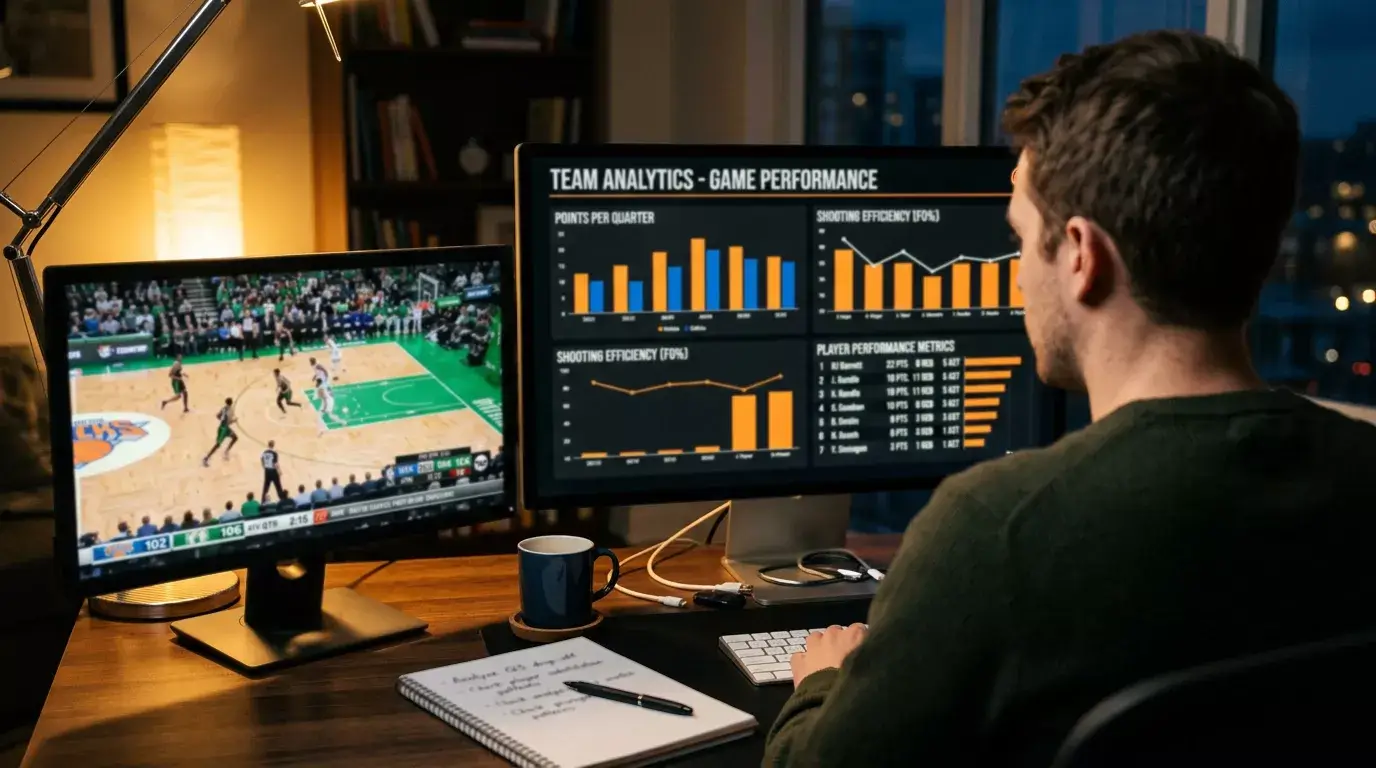
Five Steps Before You Place an NBA Player Prop
- Check the injury report: who is out, questionable, or on a minutes restriction? An absent starter redistributes usage and minutes to teammates.
- Look up the player's usage rate and the team's pace in recent games (last 10 is a useful window). Compare to season averages.
- Assess the opponent's defensive profile in the relevant stat category. A team that allows the most rebounds per game changes the calculus for a boards prop.
- Estimate projected minutes. Back-to-back games, blowout potential, and foul tendencies all reduce time on court — and every stat prop is correlated with minutes.
- Compare the bookmaker's line to your own projection. If the gap exceeds the margin, you have a bet. If it does not, move on.
One concept that consistently generates value is cascade beneficiary analysis. When a starting player misses a game — whether through injury, rest, or suspension — the remaining players absorb that player's usage and minutes. The redistribution is not equal: typically one or two teammates inherit the bulk of the opportunity. If you identify those beneficiaries before the bookmaker adjusts the line, the window of value can be significant. The Terry Rozier case from 2025 illustrated the dark side of this dynamic — insider knowledge of a player's absence being used for illicit gain — but the analytical principle itself is straightforward and perfectly legal when applied with publicly available injury reports.
The full player prop strategy guide walks through each of these metrics in detail, with worked examples and model-building frameworks for UK punters who want to move beyond intuition.
Data drives the edge, but the market you are betting into needs to be clean. The integrity landscape around NBA props has shifted dramatically — and understanding it is no longer optional.
CourtEdge proprietary tool
The Cascade Ledger
A starter is ruled out. His usage and minutes go somewhere. This engine redistributes them, projects the beneficiary's stat line, strips the bookmaker's margin out of the two-way price, and tells you whether the gap is real or just the overround.
1 · Player ruled out
2 · The beneficiary
3 · The market
Decimal prices. Most UK books toggle from fractional in the settings menu. Both sides are needed — that is what lets the engine strip the margin out.
Value on the OVER — 7.4 pts clear of the de-vigged market
Redistribution
Projection
Model vs de-vigged market
Model, over57.4%
Market, over50.0%
Prices and expected value
How the engine works. The vacated pool is usage rate multiplied by minutes. The share you assign is added to the beneficiary's own load, then the stat is scaled by minutes, by usage raised to a market-specific exponent (full weight for points, near zero for rebounds, which follow minutes rather than touches), by pace, and by a usage-efficiency tax of roughly 0.6 TS points per usage point added. The distribution around that projection widens with the square root of the mean, which is why a 30-point projection is a far less reliable over than a 6-assist one. The market side is de-vigged proportionally, so the edge shown is against the bookmaker's true opinion, not the padded price. Below a 3-point edge the engine returns no play — at a 105–110% overround, anything smaller is margin, not information. Estimates only. 18+, please gamble responsibly.
Betting Integrity: What the 2025 Scandals Mean for Prop Bettors
I remember exactly where I was when the Rozier indictment dropped — sitting at my desk, halfway through building a rebounds projection model, and suddenly staring at a news alert that made me set the spreadsheet aside for the rest of the day. Terry Rozier, a starting NBA guard, had allegedly received $100,000 for passing insider information to bettors about his own absence from a Charlotte Hornets game. Not for shaving points. Not for missing free throws on purpose. Just for telling someone he was not going to play — so they could bet on teammates whose lines had not yet adjusted.

That distinction matters enormously for anyone betting on player props. The manipulation was not about altering game outcomes or individual stat lines. It was about exploiting the information gap between injury knowledge and line movement — the exact same gap that legitimate cascade beneficiary analysis targets. The line between analytical edge and insider corruption is, in this case, the source of the information.
Adam Silver, NBA Commissioner: "It's too easy to manipulate something which seems otherwise small and inconsequential to the overall score. There's nothing more important than the integrity of the competition."
NBA Commissioner Adam Silver has been unusually candid about the scale of the problem. In October 2025, he described himself as deeply disturbed by the revelations and called for tighter federal regulation rather than the current patchwork of state-level rules in the US. His position reflects a broader reckoning within the league: the explosion of legal sports betting — over $500 billion wagered in the US since the Supreme Court opened the market in 2018 — has created financial incentives that extend all the way down to individual player decisions.
The players themselves are feeling the pressure in ways that go beyond courtroom indictments. An anonymous survey of NBA players found that 46% believe the league's gambling partnerships are actively harmful to the sport. Among college basketball players, the picture is even starker: 51% of male Division I basketball players reported receiving abuse on social media tied directly to their on-court performance, with the majority of that abuse coming from bettors who lost money.
Integrity by the numbers: 46% of NBA players say gambling partnerships harm the league. 51% of Division I male basketball players have received betting-related abuse online. Denver Nuggets forward Michael Porter Jr. has spoken publicly about receiving death threats linked to sports gambling.
Michael Porter Jr. of the Denver Nuggets put it bluntly: the whole sports gambling entity is bad and only going to get worse, and players genuinely do receive death threats. The NBPA has formally stated its support for examining tighter regulations on prop bets, describing them as an increasingly alarming source of player harassment both online and in person. The NBA itself issued a statement acknowledging that reasonable limitations on certain prop bets deserve due consideration.
For UK-based bettors, these developments might feel distant — American scandals, American regulation, American players. But the markets you bet on are priced using the same underlying data, and any regulatory restriction that limits prop bet availability in US states can ripple into how UK bookmakers structure their NBA offerings. The conversation about integrity is not just an ethical one. It is a market-structure conversation, and prop bettors who ignore it risk being caught off guard when the rules change.
The detailed analysis of the 2025 scandals covers the full timeline, the regulatory response, and what practical steps bettors can take to ensure they are operating within the boundaries of legal, regulated markets.
UK Regulatory Landscape for NBA Betting in 2026
I had a conversation with a fellow analyst in March that crystallised something I had been sensing for months. He asked me whether the Remote Gaming Duty increase would actually change how he bets on NBA props, or whether it was just a number that operators absorb. The answer is both — and neither in the way most punters expect. The regulatory landscape for UK sports betting is undergoing its most significant shift in over a decade, and every punter placing NBA wagers needs to understand the mechanics, not just the headlines.
The UK Gambling Commission (UKGC) licenses and regulates every legal sportsbook operating in Britain. If you are placing NBA bets with a UK-licensed operator, you are inside a framework that includes mandatory identity verification, deposit limits, self-exclusion tools, and complaint resolution through an independent ADR (Alternative Dispute Resolution) provider. That framework is the floor, not the ceiling — and the ceiling is moving.
Remote Gaming Duty: the shift that changes your odds
From 1 April 2026, Remote Gaming Duty rose from 21% to 40% — nearly doubling the tax rate operators pay on their gross profits from remote gambling. A new 25% remote betting duty follows in April 2027. The government expects to collect £810 million in additional tax revenue in 2026/27 alone, rising to £1.16 billion annually by 2030/31.
The practical question is what this means for your betting slip. Operators facing a near-doubled tax burden have three options: absorb the cost and accept thinner margins, reduce market offerings by cutting prop coverage or lowering maximum stakes, or widen the overround built into their pricing. The reality is a blend of all three, but the odds adjustment is the one that directly affects your expected return. If the typical NBA player prop overround was 105-107% before April, expect it to creep toward 107-110% over the next twelve months as operators recalibrate. That does not make NBA betting unprofitable — it means your analytical edge needs to be larger to overcome the house margin.
Adam Silver himself has argued that a regulated structure of legalised betting enables monitoring capabilities that were unimaginable years ago — from tracking aberrational betting patterns to geotargeting where bets originate. The UKGC has been actively enforcing that vision. In the twelve months from October 2024 to September 2025, the Commission issued 806 cease-and-desist letters to unregulated operators and blocked 314 illegal gambling websites. The government allocated an additional £26 million over three years to combat the black market — a signal that enforcement is scaling up, not winding down.
UKGC enforcement (October 2024 - September 2025): 806 cease-and-desist letters issued to unlicensed operators. 314 illegal gambling websites blocked. £26 million in additional government funding committed over three years to combat the illegal market.
For NBA bettors specifically, the enforcement landscape matters because unlicensed offshore operators often offer higher limits and wider prop market coverage — but at the cost of zero regulatory protection. No ADR, no deposit guarantees, no accountability if the operator vanishes. The UKGC framework exists to make the legal option reliable, and the ongoing crackdown on illegal sites is narrowing the grey area. The full guide to UK gambling regulation and NBA betting explores how these changes affect your market access, your tax position, and the long-term shape of NBA prop availability in Britain.
Responsible Betting: Staying in Control
I track every bet I place in a spreadsheet — have done for nine years. Not because I am unusually disciplined, but because the year I did not track was the year I lost money I could not afford to lose. That experience taught me that responsible betting is not a disclaimer bolted onto the end of a guide. It is the structural foundation that makes everything else in this article possible. If your staking is erratic, your analysis is irrelevant.
The UK has one of the most developed responsible gambling frameworks in the world, and using it is not a sign of weakness — it is a sign that you understand the mathematics of variance. Roughly 10% of the UK population participates in online sports betting, with a stark demographic split: 15% of men versus 4% of women. The NBA betting audience skews heavily toward men aged 18-34, which is also the demographic most susceptible to chasing losses and over-staking on accumulator and parlay-style bets.
Practical bankroll management starts with a number: the total amount you can afford to lose entirely without it affecting your rent, your bills, or your relationships. That is your bankroll. A standard approach is to risk 1-3% of your bankroll on any single bet, which protects you against the inevitable losing streaks that even the best analysis cannot eliminate. If your bankroll is £500, your individual stakes should sit between £5 and £15. Not exciting, perhaps, but sustainable — and sustainability is what separates punters who are still operating in five years from those who blew through their funds in five weeks.
UK-licensed sportsbooks are required to offer deposit limits, loss limits, session time alerts, and cooling-off periods. Use them. Set a weekly deposit cap before you start, not after a bad night. If you find yourself increasing stakes to recover losses, that is the clearest possible signal to step back.
UK responsible gambling resources: GamCare (gamcare.org.uk) offers free counselling and support. BeGambleAware (begambleaware.org) provides tools, information, and a national helpline. GAMSTOP (gamstop.co.uk) enables self-exclusion from all UKGC-licensed online gambling sites for a chosen period. The National Gambling Helpline is available at 0808 8020 133.
Self-exclusion through GAMSTOP applies across all UKGC-licensed online operators simultaneously — you cannot simply switch to a different bookmaker. If you are considering self-exclusion, or if someone you know is struggling with gambling-related harm, GamCare and BeGambleAware provide free, confidential support. The NBA season's length — games nearly every day for eight months — creates a relentless tempo of betting opportunities, and recognising when to stop is as important as knowing when to bet.
Frequently Asked Questions About NBA Betting in the UK
Is it legal to bet on NBA games in the UK?
Yes. Betting on NBA games is fully legal in the UK when you use a sportsbook licensed by the UK Gambling Commission (UKGC). All UKGC-licensed operators are required to comply with British gambling law, including identity verification, responsible gambling tools, and independent dispute resolution. There is no restriction on betting on American sports — the NBA, NFL, MLB, and NHL are all available markets. The key requirement is that the operator holds a valid UKGC licence, which you can verify directly on the Gambling Commission's public register. Unlicensed offshore operators are not regulated under UK law and offer no consumer protections.
What are NBA player prop bets and how do they work?
A player prop bet is a wager on an individual player's statistical performance in a specific game, independent of the game's outcome. The bookmaker sets a line — for example, 24.5 points — and you bet on whether the player will score over or under that number. Common prop categories include points, rebounds, assists, three-pointers made, steals, blocks, and combined stats like points-rebounds-assists (PRA). Each side of the line is priced with odds reflecting the bookmaker's assessment of probability. Player props are particularly popular because they allow you to focus your research on a single player's matchup, usage patterns, and recent form rather than predicting the outcome of an entire game.
What types of bets can you place on NBA players in the UK?
UK-licensed sportsbooks offer a wide range of NBA markets. Player props cover individual statistics: points, rebounds, assists, three-pointers, steals, blocks, and combo markets like PRA. Game-level markets include moneyline (picking the winner), spread or handicap (margin of victory), and totals or over/under (combined score). Same game parlays — called bet builders at most UK operators — let you combine multiple selections from one game into a single wager. Futures markets cover season-long outcomes such as the NBA championship, MVP award, conference winners, and division winners. Live or in-play markets allow you to bet during the game as odds update in real time.
How do NBA betting odds work for UK punters (fractional vs decimal)?
UK sportsbooks typically display NBA odds in fractional format (e.g., 5/2, 10/11), though most platforms allow you to switch to decimal (e.g., 3.50, 1.91). Fractional odds show the profit relative to your stake: 5/2 means £5 profit for every £2 staked. Decimal odds show the total return per unit: 3.50 means £3.50 returned for every £1 bet (including your stake). American odds, which you will encounter in US-sourced analysis, use plus and minus signs: +200 means £200 profit on a £100 bet, while -150 means you need to stake £150 for £100 profit. All three formats express the same underlying probability — the difference is purely presentational. Decimal is generally the most efficient format for comparing prices and calculating parlay payouts.
Does overtime count in NBA player prop bets?
It depends on the specific sportsbook and the market. The most common rule at UK-licensed operators is that player prop bets — points, rebounds, assists, and other individual stats — include overtime statistics by default. However, some operators settle certain prop markets on regulation time only, excluding overtime. Always check the specific settlement rules in the terms section of your chosen sportsbook before placing a bet. Game-level markets (moneyline, spread, totals) universally include overtime at all UK-licensed operators.
What is a same game parlay (bet builder) for NBA?
A same game parlay, typically marketed as a bet builder at UK sportsbooks, is a single wager that combines multiple selections from the same NBA game. You might combine a player scoring over 25.5 points with his team winning and the game total going over 220.5. All legs must win for the bet to pay, but the odds multiply, creating a larger potential payout than individual bets. The analytical challenge is understanding correlation: some combinations are positively correlated (a high-scoring player increases the chance the team wins and the total goes over), while others work against each other. Bet builders are popular but carry higher risk, as the probability of all legs winning decreases with each additional selection.
How do injuries affect NBA player prop betting lines?
Injuries are one of the most significant factors in NBA player prop pricing. When a key player is ruled out, the bookmaker adjusts lines for remaining teammates — typically increasing projected points, rebounds, and assists for those expected to absorb additional minutes and usage. The NBA requires teams to submit injury reports by 5pm Eastern Time on the day before a game (1pm for back-to-back games), creating a window between the report's publication and the bookmaker's line adjustment. During that window, prop lines for cascade beneficiaries — the teammates who inherit usage — may not yet reflect the changed circumstances, which represents a potential value opportunity for bettors who monitor injury reports closely.
Related posts

NBA Betting Glossary for UK Punters: Every Term You Need to Know

British Basketball League Betting in the UK: Markets, Coverage, and Differences from NBA